Free guide | Wine
Champagne, Decoded: a free guide to tasting and pairing Champagne
Dosage, styles, tasting and pairing. A pocket field guide to reading, tasting and serving Champagne with confidence.
By @taniameter. November 2026. 5 minute read.
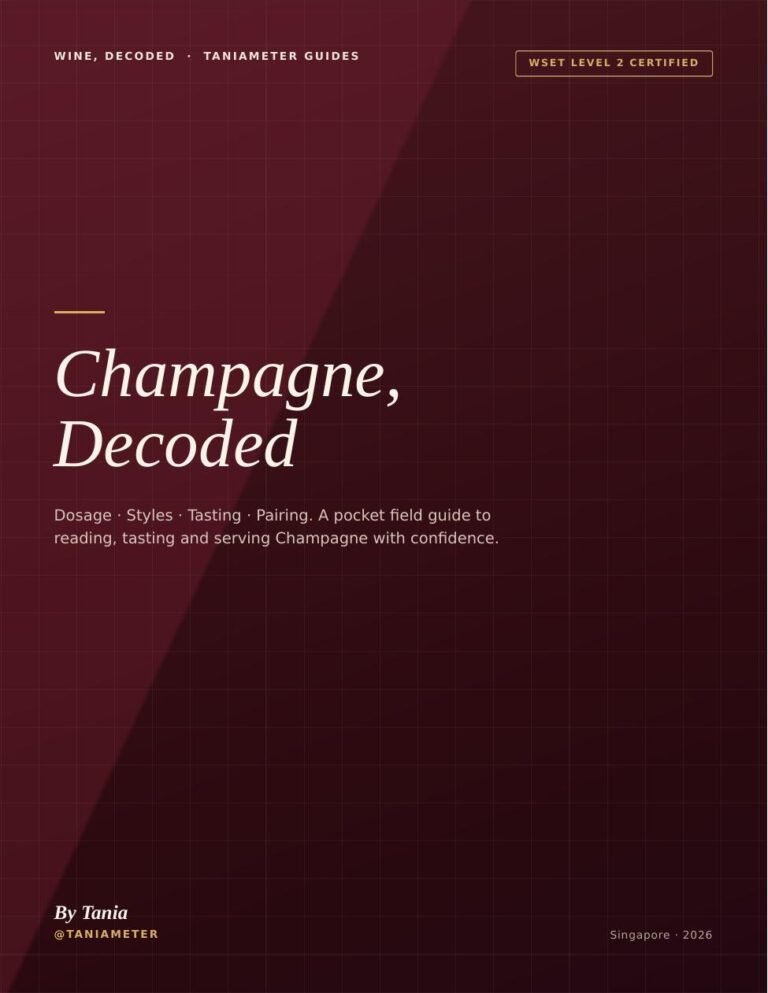
Free guide · 7 pages · PDF
Download Champagne, Decoded
Enter your name and email and the download appears instantly. You will also receive The Monthly: everything worth knowing in Singapore, once a month.
Champagne rewards a slower look: what the dosage tells you before you sip, how the bubbles carry aroma to your nose, and which dishes make each style taste like more of itself. Champagne, Decoded is my free seven-page pocket guide, written with my WSET Level 2 training and no jargon you can’t use at the table. Here is a taste of what is inside.
What does Brut mean? The sweetness scale
Dosage is the small amount of sugared wine added after the second fermentation, and it is the single biggest lever on how a Champagne tastes. Drier styles taste more mineral and citrus-driven; sweeter styles round out into orchard fruit.
Brut Nature 0 to 3 g/L, Extra Brut 0 to 6 g/L, Brut under 12 g/L, Extra Dry 12 to 17 g/L, Sec 17 to 32 g/L and Demi-Sec 32 to 50 g/L. Yes, Extra Dry is sweeter than Brut.
Blanc de Blancs, Blanc de Noirs and Rosé
Blanc de Blancs is 100% Chardonnay: lean, chalky, citrus and white flowers. Blanc de Noirs is Pinot Noir and Meunier with no red skin contact: fuller, with red apple and brioche. Rosé gets brief skin contact for red berry fruit and extra grip.
Non-vintage is blended across years for a consistent house style, the most versatile bottle. Vintage comes from one exceptional year and ages longer on lees: deeper, toastier and built to age.
How to taste Champagne
Skip the swirl; it just knocks the fizz out. Look for fine, steady bubbles. Smell with your nose just inside the rim: fruit and florals first, then bread, brioche and toast. Taste and notice where the acidity lands. Finish: count the seconds. Past eight to ten usually means real length and quality.
What to pair with Champagne
Match the wine’s weight and acidity to the dish. The saltier or richer the food, the more dosage or body you want in the glass. Oysters and raw seafood with Blanc de Blancs. Fried food, from tempura to fried chicken, with Brut NV. Roast chicken with Blanc de Noirs. Charcuterie and hard cheese with rosé. Sushi with Extra Brut. Fruit tarts with Demi-Sec. And fresh strawberries with rosé: my go-to.
How to serve Champagne
Serve at 8 to 10°C, about 45 minutes in an ice bucket. Use a tulip glass rather than a flute, so the aromas have room to open. And twist, don’t pop: hold the cork still and turn the base of the bottle. A quiet hiss means less pressure lost.
The full guide also covers the four flavour families and a short glossary, from lees to grower Champagne.
Good to know
What is the difference between Brut and Extra Brut?
Extra Brut has less sugar: 0 to 6 g/L, against under 12 g/L for Brut. It tastes drier and more mineral.
Is Extra Dry Champagne sweeter than Brut?
Yes. Extra Dry has 12 to 17 g/L of sugar, more than Brut.
What is Blanc de Blancs?
Champagne made from 100% Chardonnay: lean, chalky and citrus-driven.
What temperature should Champagne be served at?
8 to 10°C, about 45 minutes in an ice bucket.
Should Champagne be served in a flute?
A tulip glass is better. It lets the aromas open while still keeping the bubbles.
What food goes with Champagne?
Oysters with Blanc de Blancs, fried food with Brut NV, charcuterie with rosé and fruit tarts with Demi-Sec.
Is the Champagne guide free?
Yes. Download Champagne, Decoded free when you sign up to The Monthly.
Download the full guide above, and tell Tania which bottle you opened on Instagram.
More from the magazine
Taniameter
Taniameter. Singapore food, drinks, travel and tables. Follow @taniameter on Instagram.
© 2026 Taniameter. Some links on this site are affiliate links; Taniameter may earn a commission at no extra cost to you.